Organisational design to support a new strategy
Royal BAM Group (BAM) is a leading Tier 1 building contractor. Its senior leaders asked Collinson Grant to help them review and redesign the UK & Ireland division’s organisational structure.
BAM had recently brought its regional and independent operating companies into a single UK & Ireland division and was now looking to pursue a more customer intimate strategy. This prompted a need to reconsider how the organisation was structured such that it could best serve customers and elevate embedded capabilities. The leadership team recognised that the existing design—developed during earlier consolidation would not deliver this.
We aimed to create a more coordinated, less complex organisation that could make faster decisions.
A clear view of the organisation and areas for change
We worked closely with the managerial team to understand the current organisation, its strengths, and the barriers affecting its work. We found several performance limitations, including duplicated effort, inconsistent reporting lines, siloed working and unclear responsibilities.
We also examined how the structure affected communication and decision-making. Like many large, project-based organisations, BAM needed to ensure information could move quickly and reliably throughout the business. This meant removing layers of management that added cost and delay, and rebalancing spans of control that had become too narrow.
We developed options to solve these problems, concentrating on how the business faced the market and how work was coordinated between functions, projects, and regions. We worked with the senior team to develop these options, from high-level design principles to detailed working practices, team structures, and accountabilities.
A practical understanding of how work is done
To support the redesign, we used Collinson Grant’s Process Activity Analysis (PAA)—a diagnostic tool that maps the core processes within an organisation and identifies who is doing the work and how much effort is being spent on each activity. This showed how work moved between individuals, departments, and business units, and where processes were vulnerable to handoff failures, duplication, or delay.
The analysis supported open, evidence-based conversations about which practices BAM needed to keep and which needed to change. The PAA gave the managerial team confidence that the new structure was informed by how people did their work, not just how they were nominally organised.
Preparing for change and supporting implementation
We presented the proposed design to the senior leadership team and worked with them to define how key functions would operate in the new model. We supported BAM’s change team to prepare for implementation helping them to translate the high-level structure into teams, roles, and reporting lines, and giving them the tools and guidance needed to lead the transition.
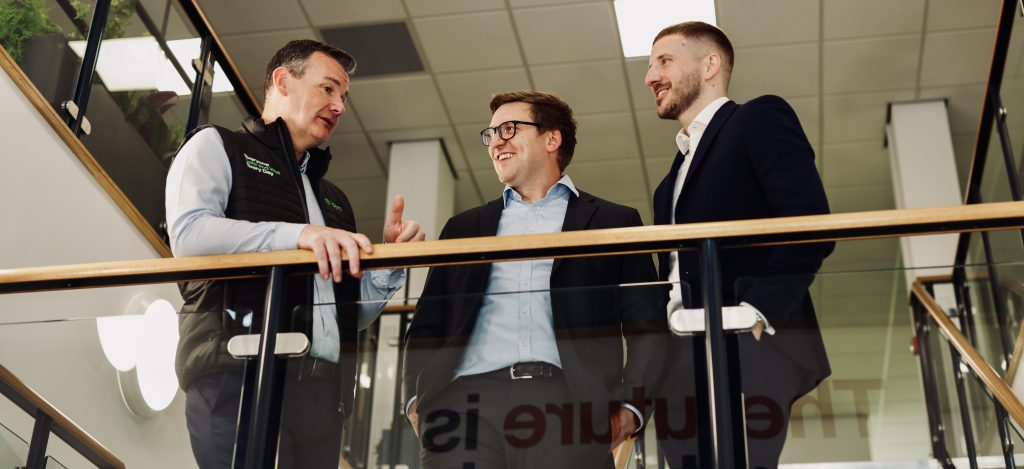
Mark Sheridan, Commercial Director of BAM UK & Ireland, with Simon Millman and Ryan McKnight from Collinson Grant